


Torque Specifications and Concepts
This article will discuss the basics of torque and torque wrench use. See also related article on Basic Thread Concepts. This article includes a table of various torque recommendations.
Introduction to Torque
Threaded fasteners, such as nuts and bolts, are used to hold many components to the bike. As a fastener is tightened, the fastener actually flexes and stretches, much like a rubber band. This stretching is not permanent, but it gives the joint force to hold together, called “preload,” or tension. Each fastener is designed for a certain range of tension. Too much tightening will deform the threads or the parts. Too little preload will mean the fastener will loosen with use. This can damage components, such as a crank ridden with a loose mounting bolt. Loose bolts and nuts are also generally the source of various creaking on the bike.
Tension in the fastener depends largely upon the amount of torque, the tightening, and the size of the thread. Generally, engineers will specify a thread size large enough to handle the anticipated stresses. For example, the M5 bolt of a water bottle cage bolt would not be a good choice for holding a crank. Even if the bolt were as tight as possible, it would not provide enough force to hold the arm secure to the spindle. The crank-to-spindle interface receives quite a lot of stress, making larger threads (M8, M12, M14) a better choice. The amount of pressure applied by a thread can be substantial in order to hold the joint secure. For example, a fully tightened crank bolt can provide over 14,000 Newton force (3,000 pounds force) as it holds the arm in place.
It is commonly believed that bolts and nuts often come loose “on their own”, for no apparent reason. However, the common cause for threaded fasteners loosening is simply lack of tension during initial assembly. Vibration, stress, use, or abuse cannot typically overcome the amount of clamping force in a properly sized and secured threaded fastener. As a simple rule of thumb, any fastener should be tightened as tight as possible without failure of the thread or the component parts. This means the weakest part of the joint determines the limits of tension, and hence, torque.
Torque Measurements
Torque for mechanics is simply a twisting or turning motion around the axis of the thread. This resistance can be correlated to, but is not a direct measurement of, fastener tension. Generally, the higher the rotational resistance, the greater tension in the threaded fastener. In other words, the more effort it takes to tighten a bolt, the tighter it is.
Torque is measured as a unit of force acting on a rotating lever of some set length. In the bike industry and elsewhere, the common unit used to measure torque is the Newton meter (abbreviated Nm). One Newton meter is a force of one Newton on a one meter long lever. Another unit sometimes seen is the Kilogram-centimeter (abbreviated kgf-cm), which is a kilogram of force acting on a lever one centimeter long. It is possible to convert between the various systems.
Also sometimes used in the United States is the inch-pound (abbreviated in-lb.).This is a force of one pound acting at the end of a lever (wrench) that is one inch long. Another torque unit used in the USA is the foot-pound (abbreviated ft-lb.), which is the force in pounds along a one-foot long lever. It is possible to convert between the two units by multiplying or dividing by twelve. Because it can become confusing, it is best to stick to one designation. The units given on the torque table here will be in inch-pounds.
It is possible to convert between the various systems:
- Nm = in-lb x 0.113
- Nm = ft-lb x 1.356
- Nm = kg-cm x 0.0981
Torque Wrenches
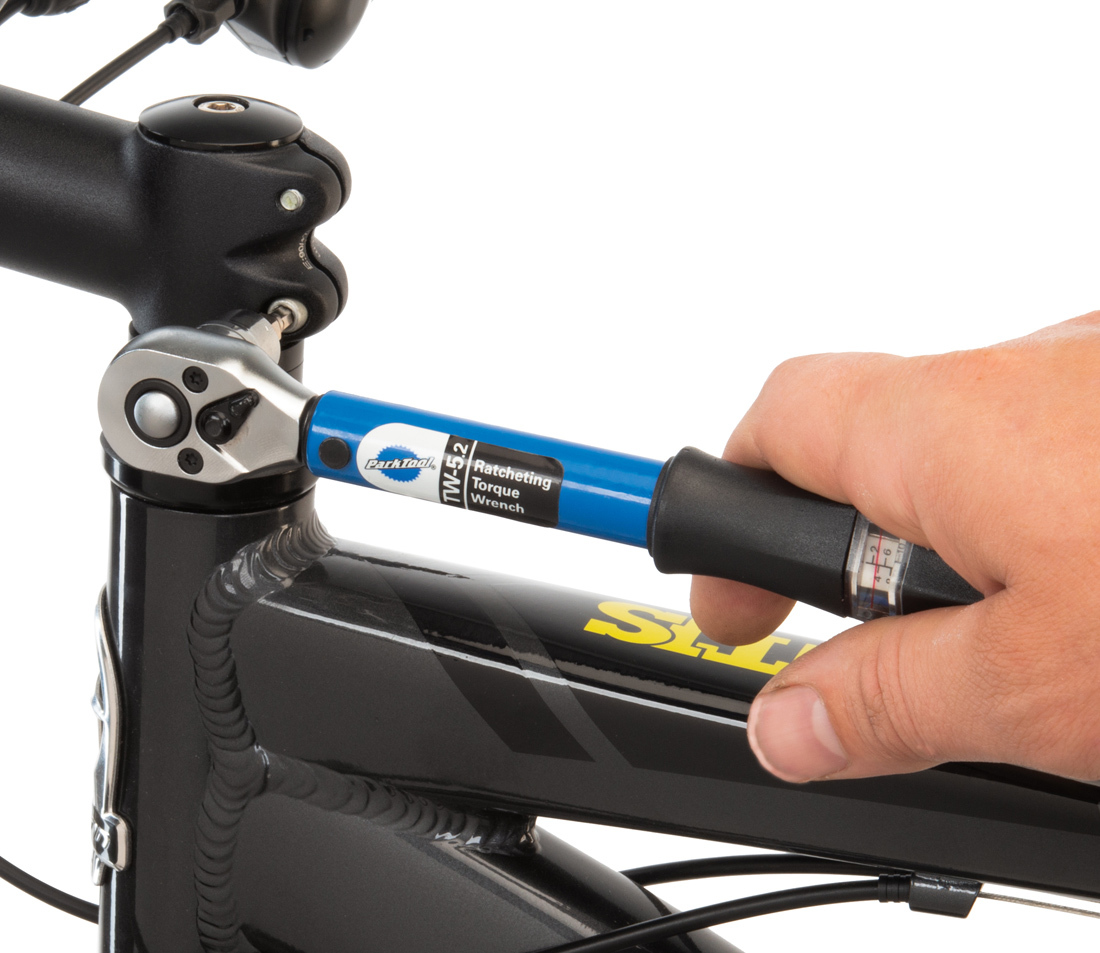
Torque wrenches are simply tools for measuring resistance to rotation. There is a correlation between the tension in the bolt and the effort it takes to turn it. Any tool, even a torque wrench, should be used with common sense. A cross-threaded bolt will not properly tighten even with a torque wrench. The mechanic must be aware of the purpose of torque, and what torque and fastener preload are doing to the component joint. It is also important to consider thread preparation, which is discussed in detail in this article.
For a full overview of torque wrench types and the best practices for each, see Torque Wrench Use and Care.
Bicycle Torque Specifications
Below is a table of torque equivalents and formulas for conversions follow the torque table. The table is also available as a PDF file.
All figures in the table below are in Newton meters and inch-pounds. Note that some companies do not specify torque for certain components or parts. Contact the manufacturer for the most up to date specifications.
Wheel, Hub, Rear Cog Area
| Component | Type/Brand | Newton Meters | Inch-Pounds |
|---|---|---|---|
| Spoke tension | Torque is typically not used in wheels. Spoke tension is measured by deflection. Contact rim manufacturer for specific tension recommendations. See TM-1. | ||
| Axle | Quick-release: closed cam type | Measured torque not typically used. Common industry practice is resistance at lever half way through swing from open to fully closed. For more see Tire and Tube Removal and Installation. | |
| Solid axle nuts (non-quick-release type wheels) |
29.4–44 | 266–390 | |
| Cassette sprocket lockring | Shimano® | 29.4–49 | 260–434 |
| SRAM® | 40 | 354 | |
| Campagnolo® | 50 | 442 | |
| Hub cone locking nut | Bontrager® | 17 | 150 |
Chris King® |
12.2 | 100 | |
| Shimano® | 9.8–24.5 | 87–217 | |
| Freehub body | Bontrager® | 45 | 400 |
Shimano® |
35–50 | 305–434 | |
| Shimano® XTR w/ 14mm Hex | 45–50 | 392–434 | |
Headset, Handlebar, Seat and Seat Post Area
| Component | Type/Brand | Newton Meters | Inch-Pounds |
|---|---|---|---|
| Threaded headset locknut | Chris King® Gripnut type | 14.6–17 | 130–150 |
| Tange-Seiki® | 24.5 | 217 | |
| Stem binder bolt: Quill type for threaded headsets | Shimano® | 19.6–29.4 | 174–260 |
| Generic brand range | 16-18 | 144–168 | |
| Threadless stem steering column binder bolts | Deda® | 8 | 71 |
| FSA® carbon | 8.8 | 78 | |
| Syncros® cotter bolt type | 10.1 | 90 | |
| Thomson® | 5.4 | 48 | |
| Time® Monolink | 5 | 48 | |
| Race Face® | 6.2 | 55 | |
| Stem handlebar binder: 1 or 2 binder bolts | Shimano® | 19.6–29.4 | 174–260 |
| Control Tech® | 13.6–16.3 | 120–144 | |
| Stem handlebar binder: 4-bolt faceplate | Control Tech® | 13.6–16.3 | 120–144 |
| Deda® magnesium | 8 | 71 | |
| FSA® OS-115 carbon | 8.8 | 78 | |
| Race Face® | 6.2 | 55 | |
| Thomson® | 5.4 | 48 | |
| Time® Monolink | 6 | 53 | |
| MTB handlebar end extensions | Cane Creek® | 7.9 | 70 |
| Control Tech® | 16.3 | 144 | |
| Seat rail binder | Shimano® | 20–30 | 174–260 |
| Campagnolo® | 22 | 194 | |
| Control Tech® two-bolt type | 16.3 | 144 | |
| Control Tech® one-bolt type | 33.9 | 300 | |
| Syncros® | 5 each bolt | 44.2 each bolt | |
| Time® Monolink | 5 | 44.2 | |
| Truvativ® | M8 bolt: 22–24 M6 bolt: 6–7.1 |
M8 bolt: 195–212 M6 bolt: 53–63 |
|
| Seat post binder* | Campagnolo® | 4–6.8 | 36–60 |
*NOTE: Seat posts require only minimal tightening to not slip downward. Avoid over tightening.
Crankset, Bottom Bracket and Pedal Area
| Component | Type/Brand | Newton Meters | Inch-Pounds |
|---|---|---|---|
| Pedal into crank | Shimano® | 35 minimum | 309.7 minimum |
| Campagnolo® | 40 | 354 | |
| Ritchey® | 34.7 | 307 | |
| Truvativ® | 31.2–33.9 | 276–300 | |
| Compression slotted crank pinch bolts | Shimano® Hollowtech® II | 9.9–14.9 | 88–132 |
| FSA® MegaExo™ | 9.8–11.3 | 87–100 | |
| Crank adjusting cap | Shimano® Hollowtech® II | 0.5–0.7 | 4–6 |
| FSA® MegaExo™ | 0.5–0.7 | 4–6 | |
| Crank bolt (including spline-type cranks and square-spindle cranks) | Shimano® | 34–44 | 305–391 |
| Shimano® Octalink® XTR® (M15 thread) | 40.3–49 | 357–435 | |
| Campagnolo® | 32–38 | 282–336 | |
| Campagnolo® Ultra-Torque® | 42 | 371 | |
| FSA® M8 bolt | 34–39 | 304–347 | |
| FSA® M14 steel | 49–59 | 434–521 | |
| Race Face® | 54 | 480 | |
| Syncros® | 27 | 240 | |
| Truvativ ® ISIS Drive | 43–47 | 384–420 | |
| Truvativ® square spindle | 38–42 | 336–372 | |
| White Industries™ | 27–34 | 240–300 | |
| Crank bolt one-key release cap | Shimano® | 5–6.8 | 44–60 |
| Truvativ® | 12–14 | 107–124 | |
| Chainring cassette to crankarm (lockring) | Shimano® | 50–70 | 443–620 |
| Chainring bolt: steel | Shimano® | 7.9–10.7 | 70–95 |
| Campagnolo® | 8 | 71 | |
| Race Face® | 11.3 | 100 | |
| Truvativ® | 12.1–14 | 107–124 | |
| Chainring bolt: aluminum | Shimano® | 5–10 | 44–88.5 |
| Campagnolo® | 8 | 70.8 | |
| Truvativ® | 8–9 | 70.8–79.6 | |
| Bottom bracket: cartridge type | Shimano® | 49.1–68.7 | 435–608 |
| Shimano® Hollowtech® II | 34.5–49.1 | 305–435 | |
| Campagnolo® (three-piece type) | 70 | 612 | |
| Campagnolo® Ultra-Torque® cups | 35 | 310 | |
| FSA® | 39.2–49 | 347–434 | |
| Race Face® | 47.5 | 420 | |
| Truvativ® | 33.9–40.7 | 300–360 | |
| White Industries™ | 27 | 240 |
Derailleur and Shift Lever Area
| Component | Type/Brand | Newton Meters | Inch-Pounds |
|---|---|---|---|
| Drop bar dual control brake/shift lever clamp bolt | Shimano® STI™ | 6–8 | 53–70 |
| Campagnolo® | 10 | 89 | |
| SRAM® | 6–8 | 53–70 | |
| Shift lever: upright/flat bar type | Shimano® STI™ | 5–7.4 | 44–69 |
| Shift lever: twist grip | Shimano® Revoshift® | 6–8 | 53–70 |
| SRAM® | 17 | 150 | |
| Shift lever: MTB “thumb type” | Shimano® STI™ | 2.4–3 | 22–26 |
| Front derailleur clamp mount | Campagnolo® | 5 | 44 |
| Campagnolo® | 7 | 62 | |
| Shimano® | 5–7 | 44–62 | |
| SRAM® | 4.5 | 39.8 | |
| SRAM® | 5–7 | 44–62 | |
| Front derailleur cable pinch bolt | Shimano® | 5-6.8 | 44–60 |
| Campagnolo® | 5 | 44 | |
| Mavic® | 5–7 | 44–62 | |
| SRAM® | 4.5 | 40 | |
| Rear derailleur mounting bolt | Shimano® | 8–10 |
70–86 |
| SRAM® | 8–10 | 70–86 | |
| Campagnolo® | 15 | 133 | |
| Rear derailleur cable pinch bolt | Shimano® | 5–7 | 44–60 |
| SRAM® | 4–5 | 35.4–44.2 | |
| Campagnolo® | 6 | 53 | |
| Rear derailleur pulley wheel bolt | Shimano® | 2.9–3.9 | 27–34 |
Brake Caliper and Lever Area
| Component | Type/Brand | Newton Meters | Inch-Pounds |
|---|---|---|---|
| Upright bar brake levers | Shimano® | 6–8 | 53–69 |
| Avid® | 5–7 | 44–62 | |
| Campagnolo® | 10 | 89 | |
| Brake caliper mount to frame: side-pull, dual-pivot, center-pull |
Shimano® | 7.8–9.8 | 70–86 |
| Campagnolo® | 10 | 89 | |
| Cane Creek® | 7.7–8.1 | 68–72 | |
| Tektro® | 8–10 | 69–89 | |
| Brake caliper mount to frame: linear-pull or cantilever |
Shimano® | 8–10 | 69–89 |
| SRAM® | 5–6.8 | 45–60 | |
| Avid® | 4.9–6.9 | 43–61 | |
| Control Tech® | 11.3–13.6 | 100–120 | |
| Tektro® | 6–8 | 53–69 | |
| Brake pad: threaded stud |
Avid® | 5.9–7.8 | 53–69 |
| Campagnolo® | 8 | 71 | |
| Cane Creek® | 6.3–6.7 | 56–60 | |
| Tektro® | 5–7 | 43–61 | |
| Shimano® | 5–7 | 43–61 | |
| SRAM® | 5.7–7.9 | 50–70 | |
| Brake pad: smooth stud |
Shimano® | 7.9–8.8 | 70–78 |
| Brake pad: side-pull and dual-pivot bolts |
Campagnolo® | 8 | 72 |
| Cane Creek® | 6.3–6.7 | 56–60 | |
| Shimano® | 6–8 | 53–69 | |
| Tektro® | 5–7 | 43–61 | |
| Brake cable pinch bolt: linear pull & cantilever |
Control Tech® | 4.5–6.8 | 40–60 |
| Shimano® | 6–7.8 | 53–69 | |
| SRAM® | 5.6–7.9 | 50–70 | |
| Tektro® | 6–8 | 53–69 | |
| Brake cable pinch bolt: side pull/dual pivot/center pull |
Campagnolo® | 5 | 44 |
| Cane Creek® | 7.7–8.1 | 68–72 | |
| Mavic® | 7–9 | 62–80 | |
| Shimano® | 6–8 | 53–69 | |
| Tektro® | 6–8 | 53–69 |
Disc Brake Systems
| Component | Type/Brand | Newton Meters | Inch-Pounds |
|---|---|---|---|
| Disc rotor to hub: lockring | Avid® | 40 | 350 |
| Shimano® | 40 | 350 | |
| Disc rotor to hub: M5 bolts | Avid® | 6.2 | 55 |
| Hayes® | 5.6 | 50 | |
| Magura® | 3.8 | 34 | |
| Shimano® | 2–4 | 18–35 | |
| Caliper body mount | Avid® | 9–10.2 | 80–90 |
| Hayes® | 12.4 9 with Manitou forks |
110 80 with Manitou forks |
|
| Magura® | 5.7 | 51 | |
| Shimano® | 6–8 | 53–69 | |
| Tektro® | 6–8 | 53–69 | |
| Hydraulic hose fittings | Hayes® | 6.2 | 55 |
Formulas for converting other torque designations into Newton meter (Nm) and inch pounds (in-lb.):
- Nm = in-lb x 0.113
- Nm = ft-lb x 1.356
- Nm = kg-cm x 0.0981
- in-lb = ft-lb x 12
- in-lb = Nm x 8.851
- in-lb = kgf-cm x 0.87
Torque Equivalencies
| Newton meter (Nm) | Approximate Inch-pound (in-lb.) | Approximate foot-pound (ft-lbs) |
|---|---|---|
| 1 | 8.9 | 0.7 |
| 2 | 17.7 | 1.5 |
| 3 | 26.6 | 2.2 |
| 4 | 35.4 | 3.0 |
| 5 | 44.3 | 3.7 |
| 6 | 53.1 | 4.4 |
| 7 | 62.0 | 5.2 |
| 8 | 70.8 | 5.9 |
| 9 | 79.7 | 6.6 |
| 10 | 88.5 | 7.4 |
| 11 | 97.4 | 8.1 |
| 12 | 106.2 | 8.9 |
| 13 | 115.1 | 9.6 |
| 14 | 123.9 | 10.3 |
| 15 | 132.8 | 11.1 |
| 16 | 141.6 | 11.8 |
| 17 | 150.5 | 12.5 |
| 18 | 159.3 | 13.3 |
| 19 | 168.2 | 14.0 |
| 20 | 177.0 | 14.8 |
| 21 | 185.9 | 15.5 |
| 22 | 194.7 | 16.2 |
| 23 | 203.6 | 17.0 |
| 24 | 212.4 | 17.7 |
| 25 | 221.3 | 18.4 |
| 26 | 230.1 | 19.2 |
| 27 | 239.0 | 19.9 |
| 28 | 247.8 | 20.7 |
| 29 | 256.7 | 21.4 |
| 30 | 265.5 | 22.1 |
| 31 | 274.4 | 22.9 |
| 32 | 283.2 | 23.6 |
| 33 | 292.1 | 24.3 |
| 34 | 300.9 | 25.1 |
| 35 | 309.8 | 25.8 |
| 36 | 318.6 | 26.6 |
| 37 | 327.5 | 27.3 |
| 38 | 336.3 | 28.0 |
| 39 | 345.2 | 28.8 |
| 40 | 354.0 | 29.5 |
| 41 | 362.9 | 30.2 |
| 42 | 371.7 | 31.0 |
| 43 | 380.6 | 31.7 |
| 44 | 389.4 | 32.5 |
| 45 | 398.3 | 33.2 |
| 46 | 407.1 | 33.9 |
| 47 | 416.0 | 34.7 |
| 48 | 424.8 | 35.4 |
| 49 | 433.7 | 36.1 |
| 50 | 442.6 | 36.9 |
Related articles
Torque Wrench Use and Care View Article
 Torque Wrench Use and Care
 Basic Thread Concepts View Article
The Park Tool Guide to Bicycle Lubricants and Compounds View Article


